Save the Heritage and The Community of Millers Point, Dawes Point & The Rocks before it’s all GONE.
Please click on the FaceBook link, Like and Share our Pages ................ www.facebook.com/millerspointsaveourhomes/ ............................ www.millerspointnotforsale.org.au/ .............................................. www.savemillerspoint.blogspot.com.au/ ...........................................
Download Petition: Double click on the Petition, so it opens then, Right click on Petition, select Save Target As, then save to the destination folder. then Print off Document.
WetheundersignedsupporttheretentionofPublicHousinginMillersPoint, Dawes Point & The Rocks.Thekeypointsof The MillersPoint,
Dawes Point & The Rocks Public Housing Tenants Group areimportantandshouldbefully
implementedby; HousingNSW,CityofSydney,NSWGovernmentandallrelevantauthoritiesandgovernmentbodies;
1. Stop the sale of Public Housing in
MillersPoint, Dawes Point &
The Rocks
2.Tomaintainthepropertiesingoodcondition
3.To make
vacant properties in MillersPoint,
Dawes Point & The Rocks available to those on the waiting list
Authorised and printed by
Barry Gardner, The MillersPoint,
Dawes Point & The Rocks Public Housing Tenants Group, 14 High Street,
Millers Point NSW 2000.
Barney Gardner, spokesperson for the Save Millers Point residents action group, told a Sydney forum of more than 100 people on June 14: “The Baird Coalition government is continuing with the policies of [former premier] Barry O'Farrell and [former housing minister] Pru Goward.”
Photo: Save Millers Point Community Housing/FB.
The New South Wales government is pushing ahead with its plan to sell off 393 public houses in the historic Millers Point neighbourhood of inner-city Sydney and force public housing tenants to move.
"The government calls it ‘relocation,' but really it's 'forced eviction'," Gardner told the June 14 meeting. "Never before has an entire suburb been moved. Millers Point is 'ground zero' for the government's policy of destruction of public housing.”
The government is harassing residents and trying to pressure them into accepting relocation to other suburbs. In part, by refusing to carry out repairs at Millers Point, the government is implementing "eviction by dereliction”.
"A number of friends and neighbours have already been pushed into moving out," Gardner said. "But already there are 60-80 empty dwellings here. Why aren't people on the public housing waiting list being offered houses in Millers Point?
"We also have a lot of support from the general community. Other suburbs are very worried about the threat to public housing tenants.
"This government is intent on getting rid of public and social housing once and for all. But, here at The Point, the fightback begins.
"Redfern Legal Centre and other community organisations have backed us all along the way.
"We also have strong support from unions. The Maritime Union of Australia has assisted us from the start. They have close historic ties to the waterfront here.
"The Fire Brigade Employees Union has supported us. And Unions NSW is moving to endorse our campaign.
"We have launched a public petition, seeking 10,000 signatures to force a debate in state parliament. We plan to organise mass handouts of flyers at railway stations, and need volunteers for letter drops.
"This community has existed for over 200 years. The National Trust has heritage-listed us as a 'living community.'
"Our message is clear: Stay solid, stick together, and we will escalate our campaign from here.”
Other speakers at the meeting included independent state MP Alex Greenwich, Labor shadow housing minister Sophie Cotsis, Sydney City Council deputy mayor Robyn Kemmis and Maritime Union of Australia state secretary Paul McAleer.
The Save Millers Point campaign is planning a Spring Picnic on Sunday September 14, 10.30am, at Argyle Place, Millers Point, to help publicise the struggle to stop the evictions.
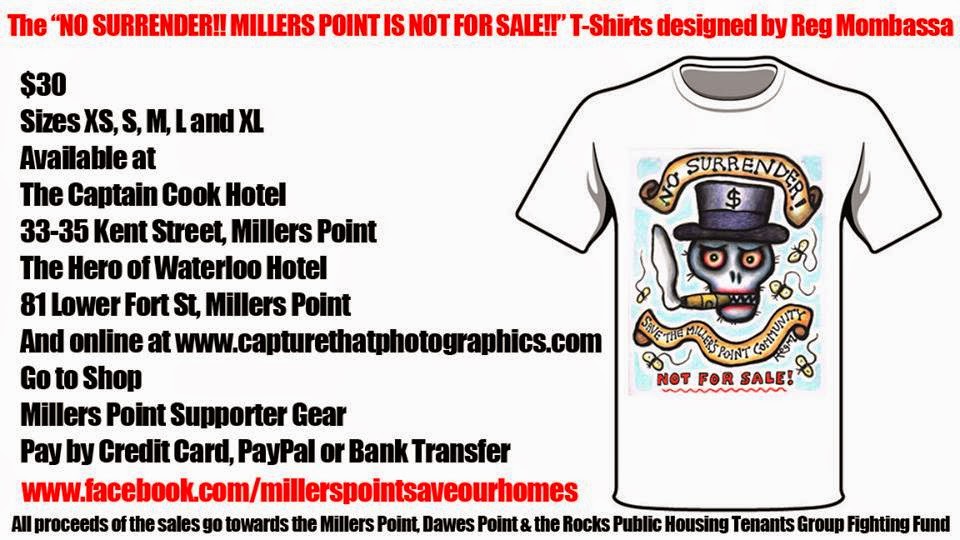
Millers Point official supporter Unisex T-Shirt. Available in X Small, Small, Medium, Large & X Large sizes. Material made from 100% Cotton. All proceeds of the sales go towards the Millers Point, Dawes Point & the Rocks Public Housing Tenants Group Fighting Fund. Designed by Reg Mombassa for the Miller's Point, Dawes Point and the Rocks PHT group.
The Millers Point context is strengthened by the contribution of the local community, which is firmly committed to the preservation of the suburb’s unique character and sponsored the heritage listing nomination to ensure the protection of Millers Point. The area is held in deep affection by the residents, many of whom have family connections that can be traced through proceeding generations of the Millers Point population, and/or have links to maritime industries. The historic, social and physical fabric of Millers Point cannot therefore be considered as separate components, but rather as interwoven traits making up the precinct so that an unusually high and rare degree of social significance can be ascribed to this area.
It is a living community with clearly discernible links to the maritime industries that formed the village's core from the early part of the nineteenth century, and one that has long-term memories of the precinct's fabric and relevance. The gentrification of an area comes at the cost of removing families from homes and individuals from areas which they were born into and their families have lived for generations. Bubonic plague broke out there at the turn of the 20th century, and many buildings were demolished. More were knocked down to accommodate the Harbour Bridge. In the 1970s the Askin government tried to demolish all housing in the area, only to be stopped by a determined community and green bans imposed by the Builders Labourers Federation.
Sydney's waterfront should not simply be for those who can afford multi-million dollar apartments. Suburbs such as Millers Point are communities made up of residents who have existed there for generations. Forced removal will destroy this community and cause distress to the current residents. Residents on welfare and pensioners are as entitled to inner city housing as any other citizen.
Our communities are invaluable no matter where they are located. And we should fight to preserve them. Not destroy them for yet another soulless, generic development. Millers Point is irreplaceable.
We are repeatedly told that we are a suburban nation, and we most certainly revere the “garden suburb” – an early-20th-century planning idea that grew in response to the ills of industrialisation, pushing housing far beyond the boundaries of the corrupting city, to where fresh air, sunlight and cheap land abounded.
We rarely acknowledge Australia’s hidden housing tradition: the model urban housing schemes that viewed the city as something to be made rather than feared. These, too, date from the early 1900s, when Sydney was ravaged by poverty and plague, and the slums of Millers Point and Observatory Hill had been resumed and vested in progressive government agencies such as the Sydney Harbour Trust.
The trust was tasked with reconstructing the city’s wharfage and rehousing the workers in hygienic and dignified conditions. In doing so, it transformed the city.
The High Street workers’ flats are one component of a public-spirited and socially progressive story that has been overlooked in favour of the aspirational lure of individualism implicit in the suburban “dream”. #savemillerspoint
The flats occupied the site of an old government quarry. A platform was carved into the exposed bedrock, making a new urban terrace, a “high street”, with an arresting V-shaped form that pitched symmetrically to a point on the axis of the Observatory dome, where the trust built a kindergarten and playground. The quarried stone was used to reclaim a 30-metre-wide street, Hickson Road, along the harbour edge below, which was lined with emphatic brick shore sheds that linked a series of hardwood finger wharves. A bridge connected High Street to the shore sheds, allowing the workers to walk to work, suspended above the teeming traffic and filthy wharves. The Barangaroo casino will soon emerge from the vast container tarmac that destroyed the wharves in the 1970s.
The workers’ flats are skilful and inventive model housing. The trust was principally staffed by engineers and brought a rationalist’s eye, technical prowess and constructive heft to the question of housing. Faced with strong resistance to the idea of monolithic tenement buildings, they developed a series of flats that masqueraded as terrace houses – a specifically Australian form of urbanism. The staggered walls and gables that serrate the High Street roof forms don’t separate individual houses, but groupings of four individual flats. #savemillerspoint
The upper and lower flats were divided by ingenious concrete panel and slab systems, to prevent the spread of fire and noise – some of the earliest use of this now ubiquitous technology in Sydney housing. Each flat had its own ventilated laundry, bathroom and scullery at the rear to ensure hygienic living conditions could be maintained.
The lower flats had a courtyard for clothes-drying and access to a rear lane for rubbish collection. The upper ones were given rooftop drying platforms. A minor engineering marvel, these platforms were made of solid hardwood beams, packed tightly side by side and bonded by steel tie rods. Brick chutes and concrete tubes allowed rubbish to be dropped to the lane below. This lane, with its syncopated chutes, latticed eyries and washing launched into the air by nifty pulley mechanisms, is a raw but captivating domestic scene. “Plain, useful, almost grim in their simplicity,” said TheSydney Morning Herald in 1912, they carry “a twinkle of imagination that may make the repose of the tired labour pleasant”.
Following their tenure as workers’ residences, the High Street flats were transferred to the Department of Housing in the mid-1980s. Although neglected, they have remained a substantive part of the city’s public housing stock until the recent announcement that they, along with the trust’s other model housing projects, will be sold to the market in 2015.
The cost of maintaining old structures underpins the economic argument for these sales, not to mention the windfall uplift in property values afforded by the adjacent gentrification of Barangaroo.
Among the Millers Point properties there are some more generic “terrace” housing types that lend themselves to a new life as market housing, but the most extraordinary and experimental of the trust’s model projects simply don’t. They are small, and their architectural typology is geared to housing as many people as possible through minimum means, not the burgeoning accoutrements of “lifestyle”.
A hundred years ago the Sydney Harbour Trust remade the city to support the booming maritime economy and its workers. Next year, we will relocate 400 public housing tenants to support the booming value of property.
This is the problem with hidden histories – we don’t learn from them. How inept it will be if the fate of these radical social projects is to become a gutted heritage curio, to house a privileged few of the wealthiest among us, while we wring our hands over the provision of affordable housing in our cities, in ignorance of this astonishing architectural legacy.
Source: Cox
A major project application has been lodged with the NSW Planning Department to expand the Four Points By Sheraton Hotel at 161 Sussex Street Sydney. The redevelopment includes construction of a 25 storey tower, comprising hotel rooms and commercial floorspace and function space.
The proposed redevelopment is possible because the current hotel does not utilise the full lease site.
The land is subject to a 99 year lease to May 2087 and currently has approximately 3,903 square metres of undeveloped site area. The existing hotel structure only occupies some 60% of the site.
There are large areas over the Western Distributor and above the Slip Road zone that while they are
within the site boundary, have not been development.
Development Opportunities- Source: Cox
The proposal is currently on public exhibition until 10 October and comprises:
231 rooms in a new 25 storey tower at the southern end of the site
A new structure over the Western Distributor for expanded meeting and banquet facilities
Upgrade to porte cochere and building entry on Sussex Street
Expanded entry for event facilities on Sussex Street
Upgrade retail frontages on Sussex Street
The proposed development has been declared State Significant Development (SSD) as it has a capital investment value estimated at $148.5 million and is located in the Darling Harbour State Significant Site precinct.
The Environmental Assessment prepared by JBA argues that the redevelopment of the Four Points By Sheraton Hotel has been proposed to respond to the current demand for hotel accommodation in Sydney. “It has been determined that there will be no adverse environmental impacts and that the potential impacts are able to be managed through the proposed mitigation measures” the reports concludes.
By Carolyn Cummins - June 13 2014 #savemillerspoint
A development site at the northern end of the Barangaroo peninsula, Millers Point, has been offered for sale amid rising demand for mixed use space in the area that is independent to the Lend Lease project.
A consortium of three private investors are selling their long-held 1-3 Munn Street offices, which adjoins the new headland park at what has been dubbed Barangaroo North. The price for the buildings offered with ground lease is estimated at $40 million.
James Parry, managing director of capital markets at Knight Frank, is advising on the sale and said it was rare for these heritage-style assets to be offered.
He said the tenant, Universal Music, had come to the end of their lease and the owners felt it was time to sell and gain traction from the adjoining Barangaroo development.
‘‘Inner city properties like these are now being seen in a new light with the proximity to Barangaroo. They can be converted into a hotel to cater for the over flow from Crown and also the new huge number of office workers that will be in the area,’’ Mr Parry said.
‘‘The are also no height restrictions or floor to space ratio restrictions on the site, making it attractive for developers. Hotel operators, office tenants, serviced apartments or strata developers are interested, but residential is not allowed.
‘‘That said, the owners have decided not to get planning approval, so it’s unclear just how much development potential there is and the price will reflect this.’’
Currently on the property are two heritage-listed sandstone bond store buildings that have been converted to 3843 square offices with parking, with a fully leased income of about $2.6 million a year.
The ultimate owner of the freehold is the Barangaroo Development Authority (BDA).
Mr Parry said BDA would consider re-negotiating the ground lease to be longer, would be interested in negotiating to move the car spaces to a nearby car park and would be interested in potentially buying the heritage buildings for a cultural centre or swapping this parcel of land for one of their parcels.#savemillerspoint
The sale comes as the office towers at Barangaroo start to take shape, in what will be considered a major financial hub of Asia Pacific.
Tenants include Lend Lease, Westpac, KPMG, PricewaterhouseCoopers(PWC), HSBC and law firm Gilbert + Tobin.
There was also market speculation that technology groups such as Google and Apple could lease office space, while Westpac could also increase its exposure, if it moved the remaining staff from the nearby 275 Kent Street head office.
Lend Lease’s chief executive Steve McCann said recently that the group had completed the leases to PWC and HSBC at competitive rents and market incentives which are lower than some of the numbers that have been quoted by agents.
He said it was a positive outcome and showed that the Sydney office market was improving.
‘‘We can offer the businesses the efficiencies they now require with activity-based working offices,’’ he said.
Following completion of the sale of the 10 per cent interest, Lend Lease's equity commitment to the towers trust company will fall from $500 million to $300 million.
There remains about 103,000 sq m to lease in the three office towers, with T1, the new home of PWC and HSBC, only 34 per cent leased.
HARRY JOHN LAPHAM was born in Millers Point when The Rocks was almost a self-contained village, with everything but a post office to its name.
Steady … Lapham thought people had changed, not The Rocks.
It was a quiet time, when the pubs closed at 6pm and electricity was yet to be connected; when the roads were mud and there were extra horses kept to haul wagons with big loads up from the ships.
Lapham lived in the area for most of his life, seeing the houses come down for the Harbour Bridge; watching the bridge go up; witnessing the neighbourhood change as people moved out and houses were divided into flats; seeing backyard coppers give way to washing machines and bathrooms built inside houses where once the dunny had been out the back, and looking on as horses gave way to cars and trucks.#savemillerspoint
His parents, Edward and Elizabeth, were born in the area, descendants of mid-19th century migrants. Their eldest son, Harry, was born in Gloucester Street (later torn down to make way for the Cahill Expressway). Edward's family had moved to Gloucester Street from Cumberland Street during the bubonic plague in the early 1900s.
The family then moved around in the neighbourhood and ended up in Dalgety Terrace, where Harry lived for most of the rest of his life. The original house had a front room, two bedrooms, a bathroom, a laundry, a toilet and a yard. The bathroom was outside but it did have a roof over it, Lapham recalled.
There the Laphams raised their children, Harry, George, Esmeralda and Betty.
Lapham's father was a coal lumper, then a drayman delivering goods to local businesses. His mother was a housewife and later, after the marriage broke down, a cleaner for city companies.
Dalgety Terrace had the Mortcliffe Eye Hospital (later the Sydney Eye Hospital) on the corner, and a mixture of people in the houses and flats. #savemillerspoint
The men were waterside workers, coal lumpers and storemen and packers.
The local children played in the streets, because the backyards were full of toilets and laundries; they were once caught playing cricket on a Sunday and taken to the Children's Court. Those over 18 were fined £2 and the younger ones were given a lecture.
The houses were all owned by the Sydney Harbour Trust. There were no leases in those days, but so long as you paid your rent, you and your house were looked after. If you wanted a repair done that you couldn't do yourself, you just popped down to the depot at the wharves and someone would come and fix it.
On weekends the Laphams and their neighbours would take a ferry to Mosman to visit the newly opened zoo and have a picnic at Clifton Gardens.
All the Lapham children went to Fort Street Public School. Harry left school when he was 14. His mother had heard of a messenger boy position at Sydney City Council and as the Depression was starting to bite, she thought he should settle into a paying job. He got£2/0/6 a week, less the sixpence, which was taken out for the hospital fund.
All the Lapham children were lucky enough to get jobs when they left school, and were never out of work.
When Lapham was 19 he was got a job with council as a street sweeper, then as a driver and a rent collector. He was emptying parking meters 47 years later when he retired.
He loved sailing and football. In fact he missed the opening of the Harbour Bridge because he was trying out for the Balmain rugby league teams (he was taken into the reserves) but he made up for it by walking across the bridge and back that evening.
With the outbreak of World War II, Lapham enlisted and stayed in the army for more than five years but he worked in the stores and didn't leave Australia. He stayed at Dalgety Terrace as his brother and sisters married and moved away.
He never married and lived with his mother until she died. After that he stayed in the house, refusing to have it renovated because he said it was the way he liked it.
When the shop and houses at Susannah Place were turned into a museum in 1993, Lapham gave the Historic Houses Trust much of his "stuff" for display. He remembered the corner store as Mr Youngein's. (Lapham thought he was German, although it turned out he was Swedish. Still, his son Jimmy changed the family name to Young during the war, just in case.)
In an interview in 2005, Lapham said The Rocks hadn't changed much; most changes had been in the people. He approved of moving the container ships to Botany and getting rid of the finger wharves, and he loved the tourist ships that brought people in for some shopping. He also loved most forms of progress and anything that made life easier for people.
In 2004 he happily moved to aged-care accommodation. He is survived by a large family of nieces and nephews.
#savemillerspoint
“I just want to put Seth Rogen’s personality and Zac Efron’s body together!”
“With that kind of data management, you’re really looking at a different kind of IT delivery service.”
Such is the banter you overhear walking around Millers Point, the steadily-gentrifying microburb squashed between James Packer’s ill-fated Barangaroo project on Darling Harbour and The Rocks, on a Friday afternoon. It does not endear you to the speakers – packs of young urban professionals, laminated platinum-blondes and spiky-haired office workers with their top two buttons undone.
They’re off to their end-of-the-week liquid lunches to be served by square-bearded waiters at the Lord Nelson, the flagship pub at the top of Argyle Street that proclaims itself the oldest in Sydney.
They part around the shuffling old man in the middle of the footpath as though he’s not there, leaving him to puff away on cheap cigarettes as they chew up the hill with gym-sculpted calf muscles. Nor do they notice the yellow ribbons tied to the front doors of the shabby old houses they pass, and they certainly don’t acknowledge the houses themselves. Such things do not exist in their world – at most they are unsightly intrusions, disfigurements to be removed with minimum fuss by men in fluoro vests who do what you pay them for, and replaced by artisan cafes and design agencies.
As much as they’d like to, the young urban professionals have so far been unable to claim Millers Point’s historic terrace houses for their own. They remain confined to office hours in the old wharves and warehouses down the hill, because the suburb is home to one of the inner city’s largest surviving public housing precincts. The people who live here are not the sort you’d expect to find on such prime real estate. They are overwhelmingly past the age of retirement, many being pensioners, and bear the marks of decades of hard work on their faces and hands.
They wear singlets and stubbies, and decorate their homes with the colours of their rugby league teams. They have names like Lawrie and Julie and Bev.
The area used to be the hub of Sydney’s thriving ports industry, with thousands of working-class families living in housing owned by the Maritime Services Board, and providing the manpower that loaded and unloaded the ships that docked in Darling Harbour.
It was here in January 1900 that the bubonic plague first broke out in Sydney, borne by rats coming off the ships. For months Millers Point was a quarantined warzone, with authorities demolishing homes and hunting rats to check the plague’s spread. The plague would end up killing 103 people in eight months. As a sign of danger, yellow ribbons were tied to the doors of houses with infected people inside.
The dockworking industry eventually died a slow death, and the wharves took on new functions as sites for high-end apartments and the Sydney Dance Company. The ownership of the public housing passed to the Department of Housing in the ’80s, but the people who worked the wharves are still there, in the houses they’ve lived in all their lives, keeping a tiny remnant of the old, working-class Sydney alive in the community they’ve built for each other.#savemillerspoint
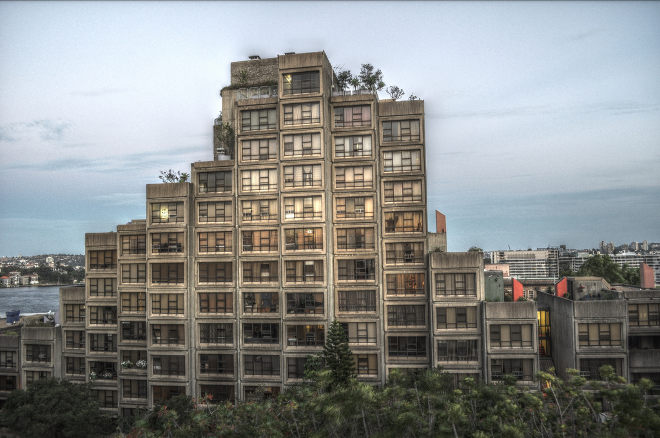
The Sirius buildling in The Rocks, one of the historic sites being sold off.
But the state government has called time. Last Wednesday, the 400-odd public housing residents of Millers Point, some of whom have 200-year-old ties to the area, found a letter from Community Services Minister Pru Goward in the mailbox telling them they are due to be evicted and their properties sold off to the highest bidder – all 293 of them. They have not been told where they may be moved, or when. The yellow ribbons, which residents again began tying to their doors last year when the sprawling Barangaroo development’s approval raised fears of just such an event, now signify death of a different kind..
It may be the first time Sydney has ever seen the eviction of an entire suburb.
“A Rich Person Wants To Live Here Now, You Need To Leave.”
The evictees are not alone, though; their representatives at all levels of government have reacted with outright fury. Federal Member for Sydney and Deputy Opposition Leader Tanya Plibersek gave a barnstorming speech in Parliament the night of the announcement, saying the O’Farrell government “may as well have dropped a bomb on the centre of Sydney for the damage they will do to the community”. By Friday, letterboxes in Millers Point and the Rocks were filled with open letters from Plibersek inviting locals to a resident’s meeting the next day at the local church hall, where the MP herself would be speaking.
-
It’s Saturday now, and around 70 people have turned up to the meeting, all very, very old. Aside from most of the politicians in attendance, Tanya’s youthful aides, her toddler Louie and Plibersek herself, the only one under 60 is a bored red-haired kid dragged along by his grandma who spends the meeting on his phone. As Plibersek speaks though, they get fired up, feeding off her anger and her determination.
“Some genius comes along every ten or twenty years thinking they can turn these houses into a quick buck – we’ve beaten them before. We can beat them again,” Plibersek says to applause. Louie hugs her legs, wrestling for her attention, and she takes a second to distract him with an iPad.
Residents gathered at a community forum on Saturday
The Shadow Housing Minister, Sophie Cotsis, is also here, and pledges to take up the fight. So does the Labor Sydney councillor Linda Scott, and the Greens and independent councillors who’ve come along as well. But the biggest applause is reserved for Bernie, the local representative of the Maritime Union of Australia (MUA). He’s a stocky, sunburned bloke in a union tee and shorts with a classic union-bruiser voice, perfect for riling up the troops. The MUA have deep ties to the old wharfie community in Millers Point, and are in this fight up to their necks. Bernie knows what the people want to hear.
“Working people have a right to security in the own homes! You shouldn’t have to wait for the government to come knocking and say, ‘A rich person wants to live here now, you need to leave’. Are we suddenly not good enough to live here?” he thunders, and the crowd rumbles its approval. A contact sheet is passed around and Tanya wraps up, stressing that she will work with “anyone, absolutely anyone, who will help protect this community”.
If that’s the case she’s going to have to coordinate with her state and local counterparts a little better; Sydney Lord Mayor Clover Moore and the independent state MP for the area, Alex Greenwich, have organised their own community forum two hours after Tanya’s, down the road. While all seem genuinely outraged by the sell-off and committed to fighting it, a streak of political one-upmanship is at play here too – the independent duo of Moore and Greenwich penned a joint column for the Herald on Thursday, pointing out that the Iemma Labor government was responsible for the first sell-offs of Millers Point public housing, back in 2008.
Blue Lucine, a Sydney-based filmmaker, is documenting the Millers Point controversy for her upcoming film, Sydney For Sale.#savemillerspoint
The Greenwich/Moore forum is in the Abraham Mott Youth Centre, a town hall that can hold around 400 people, and it takes everyone about ninety seconds to walk there from the church hall. There’s still an hour to kill until the second meeting starts, so some of the locals head to the Argyle Café down the street and huddle at a table outside. The interior is full of burly tradesmen taking a break from laying the foundations of James Packer’s monstrous six-star hotel and casino at nearby Barangaroo, which will eventually loom over the city’s skyline.
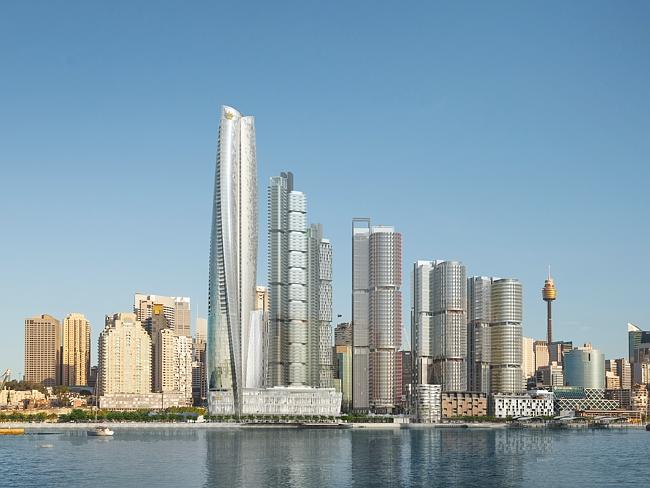
An artist’s impression of the Barangaroo development; source: crownresorts.com.au
Like the public housing up the hill, Barangaroo is publicly-owned, and was originally slated to be dominated by a waterfront park in the award-winning proposal that won the competition to redesign eastern Darling Harbour in 2006. Since then, however, the public space has been steadily chipped away by encroaching commercial interests. Danish urban designer Jan Gehl resigned from the Barangaroo project in October in protest that “concerns for the people landscape have gradually evaporated” in favour of a “strong urge to build as much as possible”.
The final nail in the coffin for a public Barangaroo came in early 2012, when Packer’s proposal for a high-rollers casino on the site was given the nod by Premier Barry O’Farrell. Since then the casino has had a golden run of luck, sailing through every part of the development approvals process so easily that accusing Packer and the government of stitching up a deal has become a common refrain of the project’s critics.
In November O’Farrell and the Labor state Opposition both agreed to the casino being built on what would otherwise have been public parkland – an exclusive casino, to which only VIP members and wealthy gamblers will be allowed entry. Regular Sydneysiders won’t even make it through the door, let alone Barangaroo’s working-class neighbours at Millers Point.
Whether or not the casino has anything to do with the sudden announcement to turf out the public housing tenants up the hill and sell their homes to the highest bidder is a matter of conjecture. It would go some way towards explaining why, in a state with 57,000 people waiting to get into public housing, many perfectly good Millers Point properties have stood empty and boarded up for years, or why residents have long complained that getting even basic maintenance inside their homes is nearly impossible.
The world has a way of giving such men what they want.
“I’ll remember that.”
When it’s nearing midday, time for the Clover/Greenwich forum, the locals head back up the hill to the Abraham Mott Centre where a huge crowd has gathered. A couple of old buggers have a smoke outside beforehand.
“How’d youse go last night?” one asks. The other, wearing a sweat-stained Rabbitohs cap, shakes his head solemnly.
“Mate, I do not wish to discuss it.” Souths took a beating at the hands of the Wests Tigers the night before. #savemillerspoint
Inside, every seat is filled, and a knot of people forms around the door. It plays out much like the one Plibersek ran two hours ago, except where she played down individual grievances to progress the meeting, Alex Greenwich opens up the floor for people to vent. A woman in the audience, Judy, talks about Greenwich’s motion on Wednesday to prevent the sell-off. She speaks with a quiet dignity that makes her anger stand out all the more. “During Alex’s speech on Wednesday afternoon, I was in the viewing gallery, and I watched what people were doing,” she says. “The minister, Pru Goward, didn’t listen to a word. She sat there talking – and laughing – all through it. All through it. And I remember that.”
When the meeting’s formally done, there’s a sausage sizzle outside, provided by the City free-of-charge. I leave the locals to talk tactics and start walking home. Along the way I pass the Sirius building, the apartment complex containing 79 public housing units due to be sold off as part of the plan Goward announced on Wednesday. It’s a bizarre, ugly thing, built like a giant set of concrete steps. At the top of one of the highest steps is the iconic sign every commuter across the Bridge has seen a thousand times, balanced in a window: ONE WAY! JESUS. It’s tried to convert unbelievers for years, but the message smacks more of frustration now.
Across the road from the Sirius building, the young urban professionals queue for the Sydney Harbour Bridge Climb, a unique Sydney experience starting at $198 a pop. They have a much better chance of conquering the Sirius building than the current tenants do of ever climbing the Bridge.
They are everywhere now, the young urban professionals, and wherever they go the 24-hour gyms and the frozen yoghurt shops go with them. Nothing messy or cluttered, nothing crass or bogan or in any way dirty, can remain in the world that is being created for them and for their money; only glistening, meaningless perfection. Only immaculate farce.
-
Alex McKinnon is a Sydney-based writer and journalist, and former editor of The Star Observer.
Geoff Turnbull is a Sydney-based photographer working for Inner Sydney Voice, the quarterly journal of the Inner Sydney Regional Council for Social Development.
#savemillerspoint
“I just want to put Seth Rogen’s personality and Zac Efron’s body together!”
“With that kind of data management, you’re really looking at a different kind of IT delivery service.”
Such is the banter you overhear walking around Millers Point, the steadily-gentrifying microburb squashed between James Packer’s ill-fated Barangaroo project on Darling Harbour and The Rocks, on a Friday afternoon. It does not endear you to the speakers – packs of young urban professionals, laminated platinum-blondes and spiky-haired office workers with their top two buttons undone.
They’re off to their end-of-the-week liquid lunches to be served by square-bearded waiters at the Lord Nelson, the flagship pub at the top of Argyle Street that proclaims itself the oldest in Sydney.
They part around the shuffling old man in the middle of the footpath as though he’s not there, leaving him to puff away on cheap cigarettes as they chew up the hill with gym-sculpted calf muscles. Nor do they notice the yellow ribbons tied to the front doors of the shabby old houses they pass, and they certainly don’t acknowledge the houses themselves. Such things do not exist in their world – at most they are unsightly intrusions, disfigurements to be removed with minimum fuss by men in fluoro vests who do what you pay them for, and replaced by artisan cafes and design agencies.
As much as they’d like to, the young urban professionals have so far been unable to claim Millers Point’s historic terrace houses for their own. They remain confined to office hours in the old wharves and warehouses down the hill, because the suburb is home to one of the inner city’s largest surviving public housing precincts. The people who live here are not the sort you’d expect to find on such prime real estate. They are overwhelmingly past the age of retirement, many being pensioners, and bear the marks of decades of hard work on their faces and hands.
They wear singlets and stubbies, and decorate their homes with the colours of their rugby league teams. They have names like Lawrie and Julie and Bev.
The area used to be the hub of Sydney’s thriving ports industry, with thousands of working-class families living in housing owned by the Maritime Services Board, and providing the manpower that loaded and unloaded the ships that docked in Darling Harbour.
It was here in January 1900 that the bubonic plague first broke out in Sydney, borne by rats coming off the ships. For months Millers Point was a quarantined warzone, with authorities demolishing homes and hunting rats to check the plague’s spread. The plague would end up killing 103 people in eight months. As a sign of danger, yellow ribbons were tied to the doors of houses with infected people inside.
The dockworking industry eventually died a slow death, and the wharves took on new functions as sites for high-end apartments and the Sydney Dance Company. The ownership of the public housing passed to the Department of Housing in the ’80s, but the people who worked the wharves are still there, in the houses they’ve lived in all their lives, keeping a tiny remnant of the old, working-class Sydney alive in the community they’ve built for each other.
The Sirius buildling in The Rocks, one of the historic sites being sold off.
But the state government has called time. Last Wednesday, the 400-odd public housing residents of Millers Point, some of whom have 200-year-old ties to the area, found a letter from Community Services Minister Pru Goward in the mailbox telling them they are due to be evicted and their properties sold off to the highest bidder – all 293 of them. They have not been told where they may be moved, or when. The yellow ribbons, which residents again began tying to their doors last year when the sprawling Barangaroo development’s approval raised fears of just such an event, now signify death of a different kind..
It may be the first time Sydney has ever seen the eviction of an entire suburb.
“A Rich Person Wants To Live Here Now, You Need To Leave.”
The evictees are not alone, though; their representatives at all levels of government have reacted with outright fury. Federal Member for Sydney and Deputy Opposition Leader Tanya Plibersek gave a barnstorming speech in Parliament the night of the announcement, saying the O’Farrell government “may as well have dropped a bomb on the centre of Sydney for the damage they will do to the community”. By Friday, letterboxes in Millers Point and the Rocks were filled with open letters from Plibersek inviting locals to a resident’s meeting the next day at the local church hall, where the MP herself would be speaking.
-
It’s Saturday now, and around 70 people have turned up to the meeting, all very, very old. Aside from most of the politicians in attendance, Tanya’s youthful aides, her toddler Louie and Plibersek herself, the only one under 60 is a bored red-haired kid dragged along by his grandma who spends the meeting on his phone. As Plibersek speaks though, they get fired up, feeding off her anger and her determination.
“Some genius comes along every ten or twenty years thinking they can turn these houses into a quick buck – we’ve beaten them before. We can beat them again,” Plibersek says to applause. Louie hugs her legs, wrestling for her attention, and she takes a second to distract him with an iPad.
Residents gathered at a community forum on Saturday
The Shadow Housing Minister, Sophie Cotsis, is also here, and pledges to take up the fight. So does the Labor Sydney councillor Linda Scott, and the Greens and independent councillors who’ve come along as well. But the biggest applause is reserved for Bernie, the local representative of the Maritime Union of Australia (MUA). He’s a stocky, sunburned bloke in a union tee and shorts with a classic union-bruiser voice, perfect for riling up the troops. The MUA have deep ties to the old wharfie community in Millers Point, and are in this fight up to their necks. Bernie knows what the people want to hear.
“Working people have a right to security in the own homes! You shouldn’t have to wait for the government to come knocking and say, ‘A rich person wants to live here now, you need to leave’. Are we suddenly not good enough to live here?” he thunders, and the crowd rumbles its approval. A contact sheet is passed around and Tanya wraps up, stressing that she will work with “anyone, absolutely anyone, who will help protect this community”.
If that’s the case she’s going to have to coordinate with her state and local counterparts a little better; Sydney Lord Mayor Clover Moore and the independent state MP for the area, Alex Greenwich, have organised their own community forum two hours after Tanya’s, down the road. While all seem genuinely outraged by the sell-off and committed to fighting it, a streak of political one-upmanship is at play here too – the independent duo of Moore and Greenwich penned a joint column for the Herald on Thursday, pointing out that the Iemma Labor government was responsible for the first sell-offs of Millers Point public housing, back in 2008.
Blue Lucine, a Sydney-based filmmaker, is documenting the Millers Point controversy for her upcoming film, Sydney For Sale.#savemillerspoint
The Greenwich/Moore forum is in the Abraham Mott Youth Centre, a town hall that can hold around 400 people, and it takes everyone about ninety seconds to walk there from the church hall. There’s still an hour to kill until the second meeting starts, so some of the locals head to the Argyle Café down the street and huddle at a table outside. The interior is full of burly tradesmen taking a break from laying the foundations of James Packer’s monstrous six-star hotel and casino at nearby Barangaroo, which will eventually loom over the city’s skyline.
An artist’s impression of the Barangaroo development; source: crownresorts.com.au
Like the public housing up the hill, Barangaroo is publicly-owned, and was originally slated to be dominated by a waterfront park in the award-winning proposal that won the competition to redesign eastern Darling Harbour in 2006. Since then, however, the public space has been steadily chipped away by encroaching commercial interests. Danish urban designer Jan Gehl resigned from the Barangaroo project in October in protest that “concerns for the people landscape have gradually evaporated” in favour of a “strong urge to build as much as possible”.
The final nail in the coffin for a public Barangaroo came in early 2012, when Packer’s proposal for a high-rollers casino on the site was given the nod by Premier Barry O’Farrell. Since then the casino has had a golden run of luck, sailing through every part of the development approvals process so easily that accusing Packer and the government of stitching up a deal has become a common refrain of the project’s critics.
In November O’Farrell and the Labor state Opposition both agreed to the casino being built on what would otherwise have been public parkland – an exclusive casino, to which only VIP members and wealthy gamblers will be allowed entry. Regular Sydneysiders won’t even make it through the door, let alone Barangaroo’s working-class neighbours at Millers Point.
Whether or not the casino has anything to do with the sudden announcement to turf out the public housing tenants up the hill and sell their homes to the highest bidder is a matter of conjecture. It would go some way towards explaining why, in a state with 57,000 people waiting to get into public housing, many perfectly good Millers Point properties have stood empty and boarded up for years, or why residents have long complained that getting even basic maintenance inside their homes is nearly impossible.
But the casino is the pet project of James Packer, the second-richest man in Australia, and it has the backing of former Prime Minister Paul Keating.
The world has a way of giving such men what they want.
“I’ll remember that.”
When it’s nearing midday, time for the Clover/Greenwich forum, the locals head back up the hill to the Abraham Mott Centre where a huge crowd has gathered. A couple of old buggers have a smoke outside beforehand.
“How’d youse go last night?” one asks. The other, wearing a sweat-stained Rabbitohs cap, shakes his head solemnly.
“Mate, I do not wish to discuss it.” Souths took a beating at the hands of the Wests Tigers the night before. #savemillerspoint
Inside, every seat is filled, and a knot of people forms around the door. It plays out much like the one Plibersek ran two hours ago, except where she played down individual grievances to progress the meeting, Alex Greenwich opens up the floor for people to vent. A woman in the audience, Judy, talks about Greenwich’s motion on Wednesday to prevent the sell-off. She speaks with a quiet dignity that makes her anger stand out all the more. “During Alex’s speech on Wednesday afternoon, I was in the viewing gallery, and I watched what people were doing,” she says. “The minister, Pru Goward, didn’t listen to a word. She sat there talking – and laughing – all through it. All through it. And I remember that.”
When the meeting’s formally done, there’s a sausage sizzle outside, provided by the City free-of-charge. I leave the locals to talk tactics and start walking home. Along the way I pass the Sirius building, the apartment complex containing 79 public housing units due to be sold off as part of the plan Goward announced on Wednesday. It’s a bizarre, ugly thing, built like a giant set of concrete steps. At the top of one of the highest steps is the iconic sign every commuter across the Bridge has seen a thousand times, balanced in a window: ONE WAY! JESUS. It’s tried to convert unbelievers for years, but the message smacks more of frustration now.
Across the road from the Sirius building, the young urban professionals queue for the Sydney Harbour Bridge Climb, a unique Sydney experience starting at $198 a pop. They have a much better chance of conquering the Sirius building than the current tenants do of ever climbing the Bridge.
They are everywhere now, the young urban professionals, and wherever they go the 24-hour gyms and the frozen yoghurt shops go with them. Nothing messy or cluttered, nothing crass or bogan or in any way dirty, can remain in the world that is being created for them and for their money; only glistening, meaningless perfection. Only immaculate farce.
-
Alex McKinnon is a Sydney-based writer and journalist, and former editor of The Star Observer.
Geoff Turnbull is a Sydney-based photographer working for Inner Sydney Voice, the quarterly journal of the Inner Sydney Regional Council for Social Development.
A historic retail storefront in the Rocks shut its doors for the final time last Tuesday.
Sydney Cove Newsagency, which is a hop, skip and a jump away from some of the city’s most expensive real estate, closed down on May 27 due to rent-related issues.
City News was informed of the closure by the previous proprietor, who began leasing the space more than 20 years ago. The man, who wished to remain anonymous, alleged that the Sydney Harbour Foreshore Authority (SHFA), as the body responsible for land management in the Rocks, had increased rent for the property by “about 60-80 per cent”.
The SHFA dismissed this allegation, saying that as per the stipulations of the five-year lease signed by the tenant in 2009, the rent would increase by three per cent upon renewal.
The tenant told City News he believed the closure of his business was reflective of the government’s neglect in nurturing ongoing entrepreneurship in the Rocks. He pointed to initiatives such as the Rocks Pop-Up Project, which encouraged artists to make temporary use of vacant buildings, but did not plan, in his opinion, for long-term solutions to vacant space.
“It’s the Liberals in power. Aren’t they supposed to support small business owners like me?” he said.
However, the SHFA pointed out that commercial vacancy rates in the Rocks have been in decline, dropping to 6.27 per cent, and outperforming the rest of the CBD which sat at more than nine per cent.
Although the Authority said it had been lenient in extending the lease beyond its expiry “to assist the tenant’s exit of the premises,” the tenant claims the SHFA informed him the nature of his business was not “necessary” and could be taken “out of the Rocks”.
When approached for comment, a SHFA spokesperson affirmed that according to industry research, “newsagencies, as a retail category, are in significant decline”.
The tenant was initially given orders to vacate the premises by May 31, but the matter is now under mediation.
State Government calls for expressions of interest from individuals, companies in prime CBD public housing. #savemillerspoint
City of Sydney councillor Irene Doutney.
While residents of Millers Point are still coming to terms with the news of their relocation, the NSW Government is calling for expressions of interest in their homes.
The Government Property website calls for individuals and companies to register their interest to purchase properties in Millers Point by completing a basic form.
City of Sydney councillor Irene Doutney, who herself lives in public housing, said she was outraged at the government’s action.
“This move by the NSW Government amounts to bullying of vulnerable people,” she said.
“The Millers Point community is in deep distress as their homes are literally sold out from under them.”
Cr Doutney said that the call for EOI “proves that the Government see Millers Point as nothing more than a cash cow.” #savemillerspoint
Cr Doutney said that the plans to remove disadvantaged people from harbour side neighbourhoods was “an act of social cleansing that we will oppose at every opportunity.”
A Government Property NSW spokesman said details of the sales process were still being finalised but there had been strong interest in the properties.
View the Government Property NSW Office’s call for expressions of interest: property.nsw.gov.au/eoi. #savemillerspoint
Central recently reported that evictees of the Sirius public housing complex were being invited to weekly ‘lucky dips’ to find alternate housing in Sydney.
If more than one resident was interested in an available property elsewhere in Sydney they were invited to take part in a voluntary ballot system which would select the tenant. #savemillerspoint
'In Australia, we recognise the natural centres of our urban areas mostly by the fingers of concrete-and-glass business towers.' Photograph: flickr
If a house is a machine for inhabiting, as Le Corbusier's famous aphorism went, then central business districts are machines for compressing, containing and concentrating an economy. Sydney's CBD, specifically, is a machine for concentrating a very large number of white-collar workers, dominated these days by financial and professional services, and reaping the aggregation effects: get all of those lawyers, accountants, financiers and managers together, close enough to go to the same coffee shops and have cigarette breaks on the same corners, and you've got yourself a powerful economic entity. For better or worse, Sydney's centre is a business park on steroids.
In Australia, we recognise the natural centres of our urban areas mostly by the fingers of concrete-and-glass business towers. Much of that expansion was the product of gut-level politics: what to keep, what to abandon, and why. What we think of as "heritage" in the Sydney CBD is the layered leftovers, everything that for various reasons was never bulldozed, flooded, or remodelled into something "better".
Nostalgia, in Sydney, is for the weak.
The 19th century city started out as a brutal little torture port, crammed with workers and animals. As it grew bigger and got respectable, three things identified its edges: factories, wharves, and cemeteries. Nineteenth century Sydney had a bit of a morbid habit of laying the dead to rest at the urban fringe, then deciding the land was more useful for the living. Sydney Town Hall was built on the old Sydney burial ground. The 19th century central station wasn't exactly located where it is now; its current site used to be the Devonshire Street cemetery. If development had to happen, the past had to make way, even when that past was embodied in human remains. Sydney has been a ruthlessly modern city. Not only has it turned its face from its own European heritage, it has most of all tried to erase the 40,000 years' heritage of its first, Aboriginal, inhabitants. 'The 19th century city started out as a brutal little torture port.' Harbour scenes, Circular Quay Photograph: flickrSomething new happened in the aftermath of the second world war: we started becoming concerned about the real costs behind the prosperity metaphor of cranes on the city skyline. Instead of always celebrating the destruction of the older built environment, political movements started framing what was going on in terms of loss. In already-developed cities across the world, people began to worry about the costs to old buildings and established neighbourhoods. Citizens started seeing our cities not just as places in space but as culturally significant artefacts in their own right, deserving of protection.
The results are part of folklore. In the 1960s and 1970s, if you wanted to work in the construction industry, or if you wanted something built, you joined or dealt with the famously militant Builders Labourers Federation (BLF). They were a serious union, a left-wing closed shop which prospered on their ability to get pay rises and stop its members getting killed in preventable accidents.
When a group of residents in the upper-class Hunters Hill asked the BLF in 1971 to help save a piece of bushland from property developers AV Jennings, the real fight started. The union's refusal to work on the site – what has since been called a "green ban" – was taken by the developer as a pretext to go ahead anyway with non-union workers. The BLF threatened to stop work on an AV Jennings office block in North Sydney in response.
There isn't a community campaign anywhere that won't shamelessly compare itself to the green bans movement, which grew throughout the 1970s. In practice, the green bans had a class and union aspect which contemporary urbanists forget about: the BLF was a working-class organisation that merely saw its remit more widely than most unions, figuring that since its members were in the business of demolishing and building, they might as well have a say in what they put up or down – especially when they were talking about working class housing. It was not as though a union simply, one day, saw value in heritage arguments for the preservation of the built environment fabric.
'In practice, the green bans had a class and union aspect which contemporary urbanists forget about: the BLF was a working-class organisation which merely saw its remit more widely than most unions.'
The minister formerly responsible for public housing in NSW, Pru Goward, added a perverse footnote to this history in March when she pushed through the sale of the Millers Point housing estate. She argued that the value of the estate could be best deployed buying more and better housing away from the CBD, and at least in terms of the value she is right: it's the location and preserved heritage aspects of the Millers Point housing stock that make it worth so much money. In this case there's at least a part of the green bans legacy (the valuation of the historical built environment) which is being deployed against the kinds of working class men and women who started it in the first place.
Urbanism abounds in ironies like this. The Burra Charter, the 1979 set of basic heritage principles used by Australian planners and historians, places "cultural heritage" front and centre in the decision making process. It is deliberately, provocatively, broad in its remit: places, not just individual sites, are its objects. A more recent 2011 ICOMOS statement, the Madrid Document, specifically includes 20th century architecture in the context of heritage. The heritage sector isn't about protecting what's profitable, or good for the economy, but rather, that which is intangibly important – and that past starts now.
The 20th century central business district, which was largely designed and constructed in the context of furious, enthusiastic abandonment of the past, is now falling under the protection of legal regimes of heritage. It's being appreciated as worthy fabric too. There's a growing appreciation for brutalism as an architectural style, for example. The old light rail line that people remember running through the Sydney CBD is to come back, though naturally without the central tram depot that used to sit on Fort Macquarie (now the site of the Sydney Opera House, listed by UNESCO as having World Heritage, along with the Pyramids and Taj Mahal). 'Urbanism abounds in ironies.' Sydney Opera House under construction, 1968 Photograph: Phillip Capper/flickrA central city so dominated by office space exerts a powerful force on Sydney's culture of work and travel. The simple fact of the CBD's existence protects rather old patterns of work and communication. There is no inherent reason that nine-to-six, Monday to Friday office hours should be kept, as opposed to those which suit employees better; but central offices served by a radial transport network tend to make that pattern convenient. There's no inherent reason it should be a matter of status for a firm to have an office in the city, rather than the suburbs; but, culturally, a Collins, Macquarie, or Bourke Street address really does matter.
There are plenty of good reasons why suits and jackets are unsuited to the Australian climate, but air conditioning makes that style of business-uniform dress possible. We've got a historical city of offices which were designed before the Internet, and that architecture tends to determine work practices. What of this kind of accidental heritage demands protection? Is office presenteeist culture part of the cultural fabric of the CBD, worth preserving in place?
We have patterns of commercial land use in which we can read the past. In Australian cities we have long suburban retail strips, developed around 19th and early 20th century tram lines; we have central department stores designed to cater to the new middle class consumers who emerged after the first world war; we have larger developed post-second world war shopping centres attracting car-owning shoppers; and most recently there has been a growth in suburban one-store big box retailers (IKEA and Bunnings being the best examples).
Commercial and residential patterns do change over time, but with some amount of difficulty, and always subject to the past. In Australian inner suburbs, terraces have been turned into shopfronts and bars. What were once inner-city warehouses and factories have become in-demand housing and office space. Developers drawing up skyscraper developments that once might have been sold as offices, suddenly, are relabelling them as apartment housing for a new booming demand for units in the city.
The economy of cities tends to change rather faster than any system of land-use can account. And to a great extent, this was always the point of the concept behind the central business district: that it could be an area governed by the new, forever reinventing itself – modernity, in the famous phrase, melting the solid into air.
The Knitting Nannas Against Gas are calling on Lismore MP Thomas George to better represent his community on the issue of unconventional gas, or leave office.
Louise Somerville, one of the Knitting Nannas Against Gas, say the group will continue to protest outside the office of Lismore MP Thomas George until he speaks out against unconventional gas exploration in the region. (ABC Local:Margaret Burin )
Every Thursday afternoon for the past 18 months, the Knitting Nannas have unpacked their chairs and yellow balls of yarn and sat outside Thomas George's Carrington Street office.
Knitting Nanna Louise Somerville says the state member for Lismore is not representing his community on the most important issue in his electorate.
"We're ashamed of him. He's let us down. We pay him," she said.
"He's got to start representing us."
Last week the NSW Office of Coal Seam Gas suspended petroleum company Metgasco's licence to drill for gas at Bentley.
In a separate announcement, Resources Minister Anthony Roberts referred the project to the Independent Commission Against Corruption (ICAC).
Despite the suspension, the Knitting Nannas have vowed to maintain their vigil outside Mr George's office each week until the Nationals MP speaks out publically against unconventional gas exploration in the Northern Rivers.
Ms Somerville says in a meeting with Thomas George, she took in photos of her own children to voice her concerns about the gas industry.
"I put them in front of him and said 'this is my future'...you need to seriously look at these pictures and think about these kids and their future.
"He's more than once said 'what can I do?', but it's just not good enough."
Thomas George has declined ABC North Coast's request for an interview